


Five months into 2026, JioHotstar’s Chiraiya is the most-watched fiction series of the year in India on streaming, with an estimated viewership that’s likely to close around the 20 million mark, as per Ormax StreamView, which reports the number of Indian audience who watched a property on streaming for at least 30 minutes.
Chiraiya’s achievement looks even more impressive when seen in the context of what it doesn’t have going for it. It isn’t a franchise, doesn’t lean on marquee star power, and is produced on a relatively modest budget. In a category where big-budget spectacle, established casting, and high-decibel marketing are often treated as key success drivers, Chiraiya offers a compelling counterpoint for Indian streaming originals.
OPR Driver Profile
A useful lens to understand Chiraiya’s success is what we call a show’s driver profile. A combination of various drivers leads to Ormax Power Rating (OPR), our proprietary metric to measure audience likeability of all content, ranging from theatrical films to streaming originals to linear television shows. OPR is reported on a 0-100 scale, and can be seen as a representation of the show’s inherent content strength, and is also a surrogate for its advocacy, i.e., % audience who are likely to recommend the content to their friends or family after watching it. OPR is a critical parameter in all our content testing tools, including Ormax Stream Test, which is deployed to test streaming originals.
Chiraiya’s OPR is currently tracking at 67, which is a breakout score. For a show that doesn’t carry the benefit of franchise, cast or scale, OPR becomes particularly important, because it gives the show longevity. Chiraiya opened at modest viewership levels of 2 million on its first weekend, but stayed in Ormax Stream View’s weekly Top 50 charts for nine long weeks, because of the strong advocacy it generated.
OPR drivers are benefits that audience seek from content, and are factors that can have a positive influence on a show or film’s audience engagement, once they have decided to watch the content in question. 16 OPR Drivers for streaming fiction series have been identified using qualitative research. New research is conducted every six months to identify any new drivers that may emerge. Driver profiles form a crucial component of Ormax Stream Test. Post a show’s release, its driver profile is re-generated using data collected from viewers of the show. (Driver names are fairly self-explanatory, but detailed definitions are available on request)
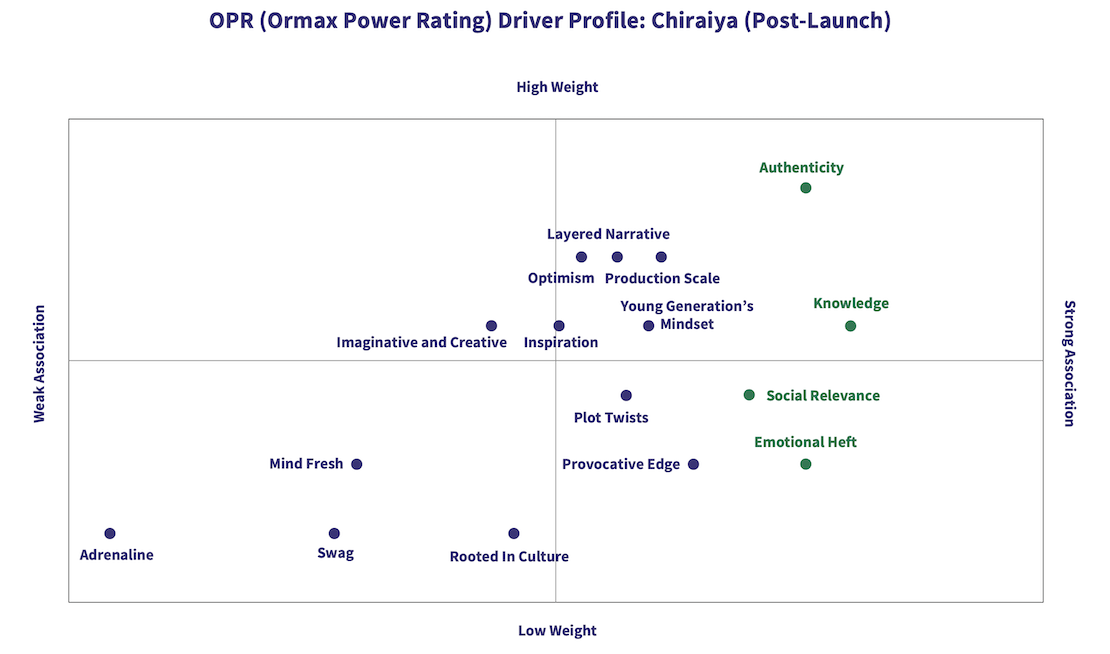
The chart below shows Chiraiya’s driver profile, based on post-launch audience research. The vertical axis reflects the relative weight of each driver (derived from modelling across past hit shows), while the horizontal axis shows how strongly Chiraiya is associated with each driver. Put simply, the more drivers that sit to the right of the vertical axis, the stronger the show’s likeability and advocacy.
Chiraiya: The Drivers Quartet
Chiraiya’s top four drivers are Knowledge, Emotional Heft, Authenticity and Social Relevance. This combination is telling. Most franchise-led successes that score high on OPR tend to over-index on more “extrinsic” drivers such as Plot Twists, Production Scale, and Adrenaline. Chiraiya, by contrast, is being powered by more “intrinsic” drivers, resulting in deeper emotional engagement and a stronger sense of real-world relevance for the audience. In effect, the show challenges several conventions in the category, leading to important learnings, three of which are detailed below.
Strong premises can create discovery advantage even without stars or franchise equity
Some ideas are inherently strong at the premise level. They do not need to depend only on scale, star power or franchise to generate audience curiosity. Chiraiya’s core subject, marital rape, sits in such a cultural whitespace. It is a topic that is socially charged, emotionally uncomfortable, widely relevant, and yet under-explored in mainstream Indian content.
Strong performance on drivers Knowledge and Social Relevance reflect the strength of show’s premise. The audience are not just watching a story but also entering a world and a conversation they feel they should know more about. This gives the show an in-built relevance that can cut through clutter.
The learning for platforms is that there is value in actively identifying such cultural whitespaces: subjects that are widely familiar as lived realities, yet under-represented in entertainment storytelling. When these ideas are executed with accessible narrative choices, they can deliver disproportionate impact, even without the usual pre-release advantages.
Socially relevant stories can scale when treated with a ‘mass’ emotional grammar
One of the reasons the show has travelled widely is that it does not treat marital rape only as a restrained, issue-led drama. It uses a more direct and accessible emotional grammar to take the subject to a wider audience. This is reflected in the show’s strong association with the Emotional Heft driver. Chiraiya builds its engagement through heightened emotions, strong confrontations, clear moral positions, and dramatic dialogues. These are not weaknesses in the treatment; they are part of what makes the story emotionally legible and easy to engage with at scale.
The learning for platforms is that “premium” streaming storytelling need not always mean subdued or understated storytelling. For many Indian audiences, especially beyond a narrow urban segment, emotional clarity and strong dramatic payoffs remain central to engagement. Chiraiya shows that a show can take on a bold subject while still using a more ‘mass’ and emotionally expressive treatment. This combination can help an issue-led original move beyond appreciation, and generate wider audience pull.
The next relatability opportunity may lie beyond youthful and urban stories
Chiraiya suggests that there is a larger opportunity in stories built around familiar Indian institutions such as marriage, family, community, patriarchy, reputation and social judgement. This is where the show’s strong association with the Authenticity driver becomes significant. The world of Chiraiya does not feel authentic because it is culturally specific in a decorative sense, but because the behaviour feels recognizable. The family dynamics, social pressures, gender equations and everyday power structures feel close to lived reality for a much wider audience.
The learning for platforms here is that relatability should not be seen only through the lens of young or cosmopolitan India. There is strong potential in adult relationship dramas and family-social stories that reflect how people actually negotiate power, morality and reputation in Indian society beyond the big cities. These stories may not always look “big” on paper, but when built with sharp conflict and credible behaviour, they can travel widely because the audience recognizes the truth of the situation.
To summarize, Chiraiya’s performance suggests that Indian streaming originals can build strong audience pull through a combination of culturally sharp premises, emotionally forceful storytelling, and recognizable social behaviour. Its success is not a rejection of star power, scale or genre-led entertainment; it is a reminder that breakout appeal can also come from ideas that feel urgent, conflicts that feel inherently dramatic, and worlds whose truths are instantly familiar to the viewer.
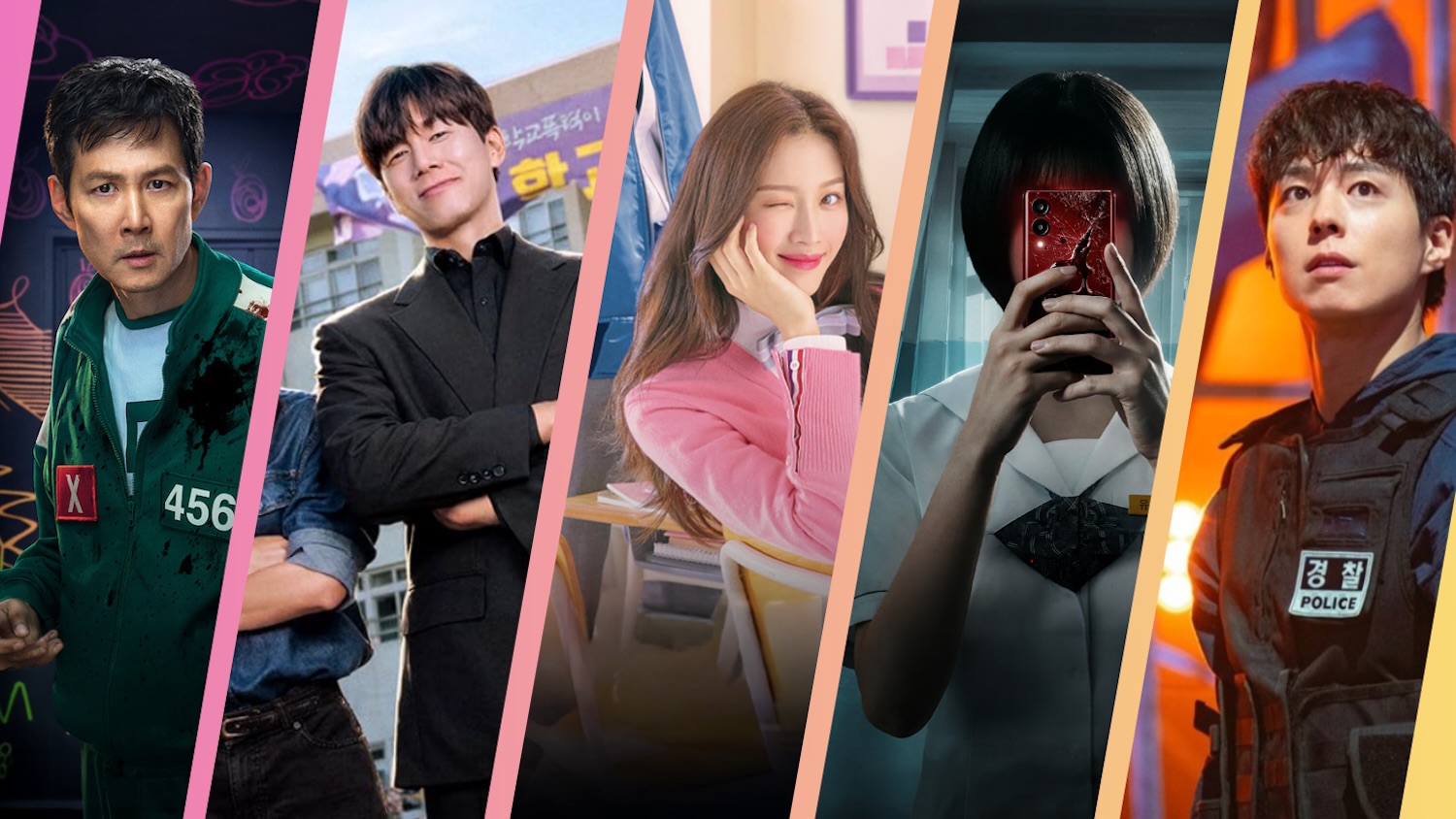
K-Dramas in India: The growth story in numbers
Nine key data points from The Ormax OTT Audience Report: 2026 and Ormax StreamView, that showcase the growing consumption of K-Dramas in India
The Ormax OTT Audience Report: 2026
The latest edition of The Ormax OTT Audience Report sizes India’s digital video universe at 664.9 million users. The CTV universe has grown by a staggering 60% in a single year, to 206.9 million
The Connected TV Era: India's New Prime Time
A new report by WPP Media and The Trade Desk, in partnership with Ormax Media, explores India’s rapidly-evolving CTV landscape, and what that means for marketers today
Subscribe to stay updated with our latest insights
© 2026 Ormax Media Pvt. Ltd. All Rights Reserved.
Ormax Media Pvt. Ltd.
402, Signature,
Captain Suresh Samant Marg,
Andheri West, Mumbai 400053
Phone: +91 9324939911
Get to know us


We use cookies to improve your experience on this site. To find out more, read our Privacy Policy