


By Our Insights Desk
Launched in 2010, Ormax Cinematix (OCX) is our proprietary campaign tracking and forecasting tool for theatrical film releases in eight major languages, tracking over 750 films every year. OCX surveys 2,000 theatre-going audiences every week, capturing their engagement with upcoming releases through three key parameters: Buzz, Reach, and Appeal. This data, when combined with market factors such as release scale, ticket price, and holiday release, is used to forecast the first-day box office (domestic) of the tracked films. This parameter, known as FBO serves as the cornerstone of OCX, relied upon by numerous subscribers across languages.
Box office forecasting is complex, involving an interplay of over 20 variables across both demand and supply sides. The comparison between FBO and actual film openings has sparked considerable discussion within the Indian film industry. At times, perceptions of a film’s ‘accuracy’ emerge more from hearsay than from actual data, as OCX reports are still widely pirated in the industry despite our efforts to curb this practice.
In light of this, we started a monthly blog from October 2024, which compares the forecast (FBO) with the actual openings of major films released each month. Actual box office data can vary by source, so Ormax generates its own estimates using a mix of reliable industry sources. These estimates will serve as the source for actual first-day box office numbers in this blog too. For questions about OCX or the box office figures in this blog, you can reach us at reports@ormaxworld.com.
This is the May 2026 edition of this blog. Please use this link to download a summary of FBO vs. Actual comparison for all major May releases in India.
Hindi Releases
There were three major Hindi releases in May 2026, whose FBO vs. actual performance is summarised in the chart below.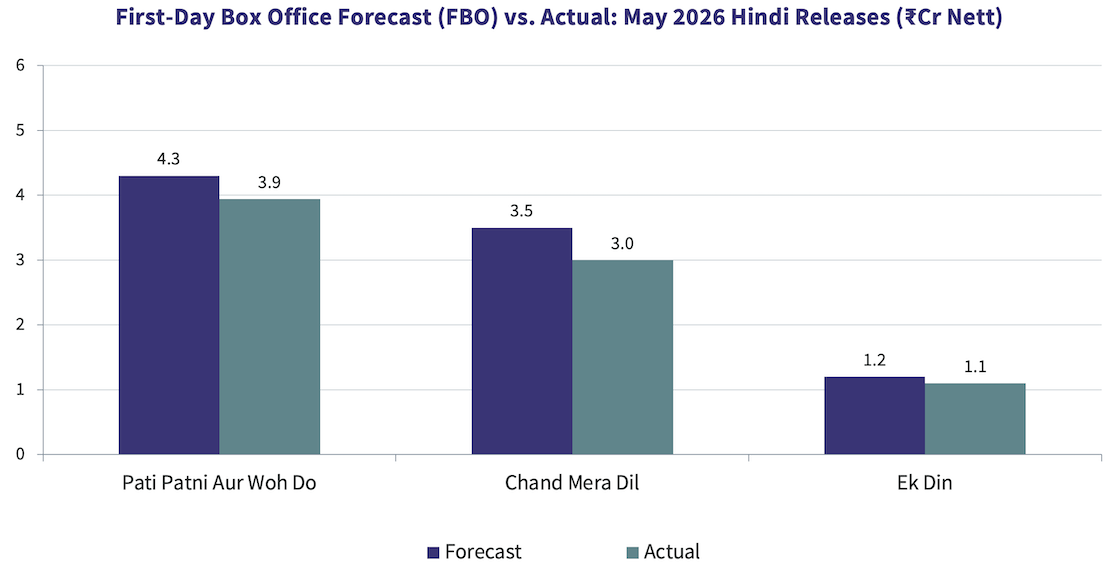
The model delivered good accuracy across all three Hindi releases, with each film opening slightly below its FBO, but without deviations of only ₹10-50 lakhs. Overall, the month reflects the model’s ability to size mid-scale Hindi releases accurately.
International Releases
This month saw three major International releases: The Devil Wears Prada 2, Mortal Kombat II, and Obsession. The chart below captures their actual first-day domestic box office and their FBO, excluding paid previews.
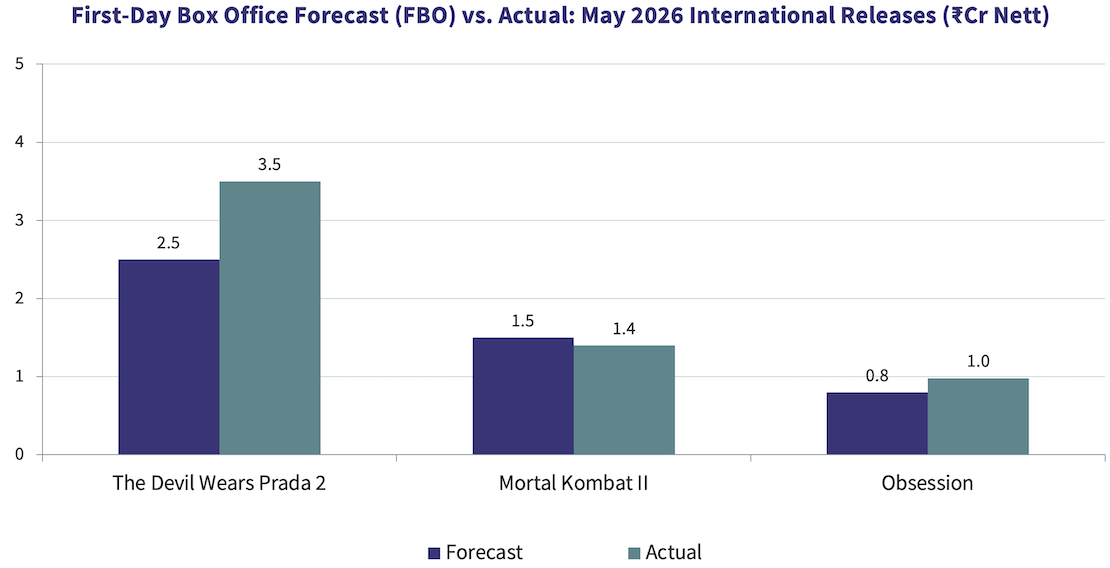
Mortal Kombat II was forecast with strong accuracy, with its actual opening of ₹1.4 Cr nett being only 7% below its FBO of ₹1.5 Cr nett. Obsession opened 18% higher than its forecast due to strong social media buzz leading to organic growth through the course of its first day, albeit on a small base.
The Devil Wears Prada 2 opened at ₹3.5 Cr nett, i.e., 29% higher than its FBO. The film benefited from demand from a premium urban audience cohort, including non-regular Hollywood theatre-goers, reflecting the enduring recall of the 2006 film.
Drishyam 3
The chart below captures the FBO vs. Actual performance for the major theatrical release of the month, Drishyam 3, across the southern markets.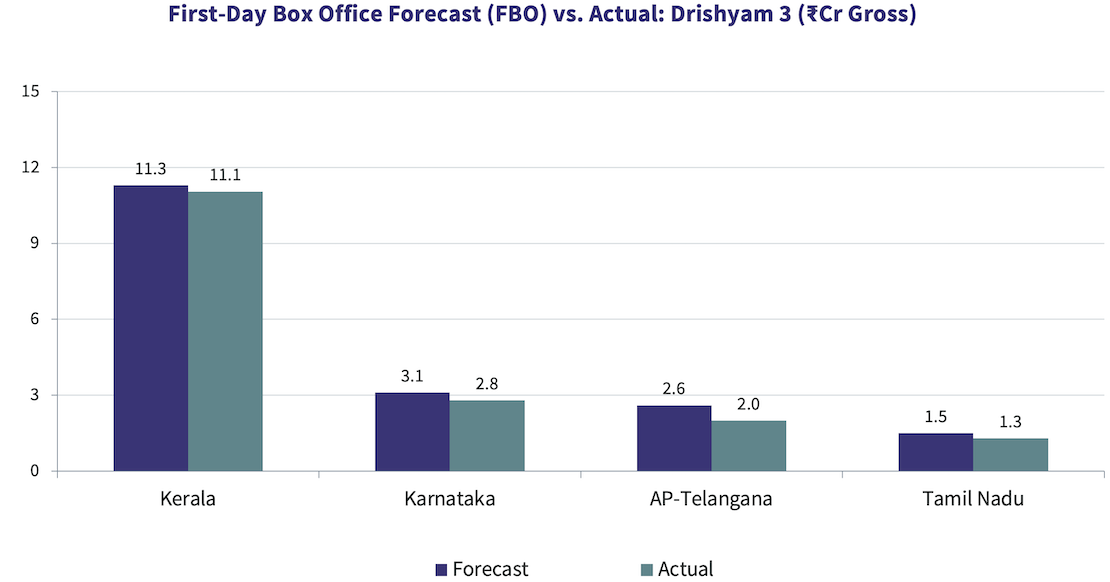
Drishyam 3 was forecast with strong overall accuracy, with its combined opening across the four markets in the chart being ₹17.2 Cr gross against an FBO of ₹18.5 Cr gross, a deviation of 7%. The model was especially accurate in the film's primary market of Kerala, where the film opened at ₹11.1 Cr gross, just 2% below the forecast of ₹11.3 Cr gross.
Karuppu
The chart below captures the FBO vs. Actual performance for Karuppu, across Tamil Nadu and AP-Telangana (where it released as VeeraBhadrudu).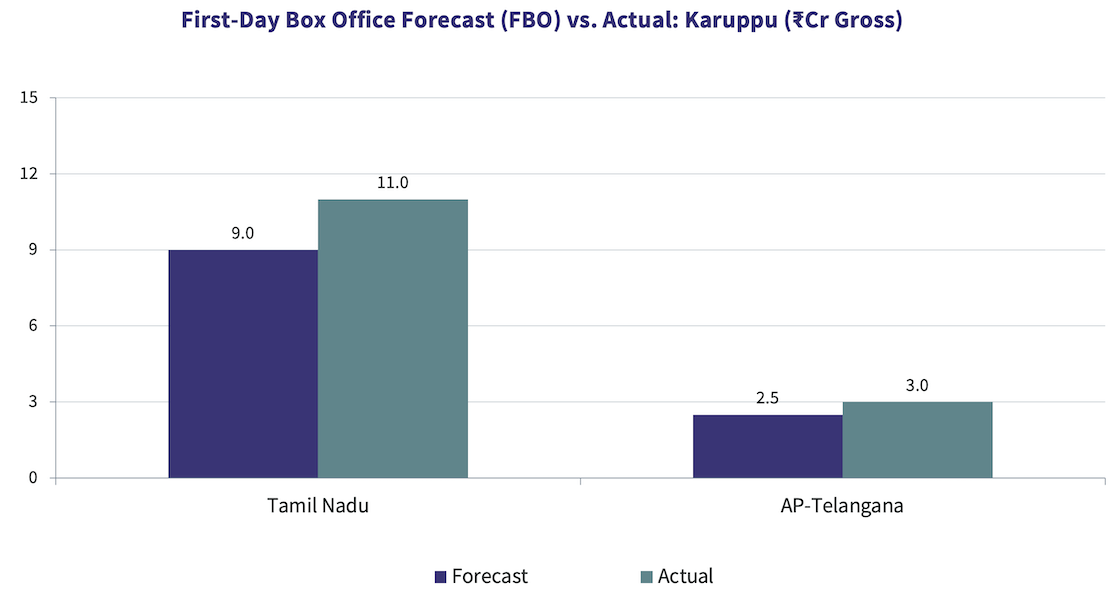
The film over-delivered its FBO in both markets. In Tamil Nadu, Karuppu opened at ₹11.0 Cr gross against an FBO of ₹9.0 Cr gross. In AP-Telangana too, the film opened 17% higher than forecast. This is primarily due to the strong word-of-mouth associated with the film, that would have boosted evening collections. The film is tracking at breakout OPR (Ormax Power Rating) level of 76 currently, underlining the impact of positive word-of-mouth.
Other Major South Releases
There were five other prominent South releases in the month of May, whose FBO vs. actual performance is summarised in the chart below.
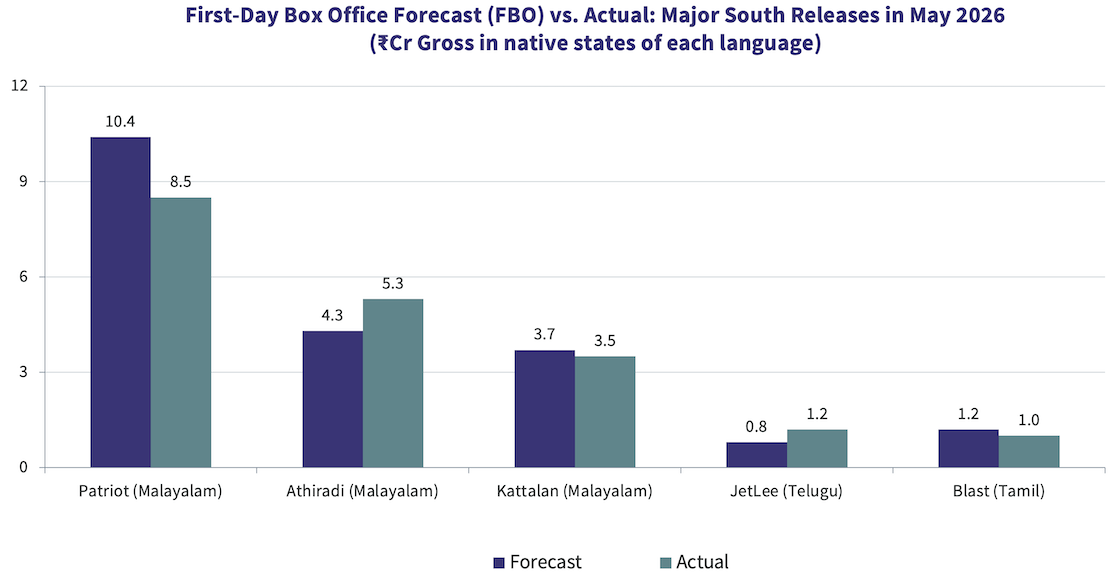
Among the Malayalam releases, Kattalan was forecast most accurately, opening at ₹3.5 Cr gross against an FBO of ₹3.7 Cr gross. Patriot, the biggest South opener in the set, opened 22% below forecast, while Athiradi over-delivered by 19%. Deviations of 15-20% for South language films are an outcome of the positive or negative word-of-mouth and reviews generated by these films during the course of their first day, resulting in an increase or drop in footfalls.
Raja Shivaji
The chart below captures the FBO vs. Actual performance for Raja Shivaji, across Marathi (original) & Hindi (dubbed) language versions.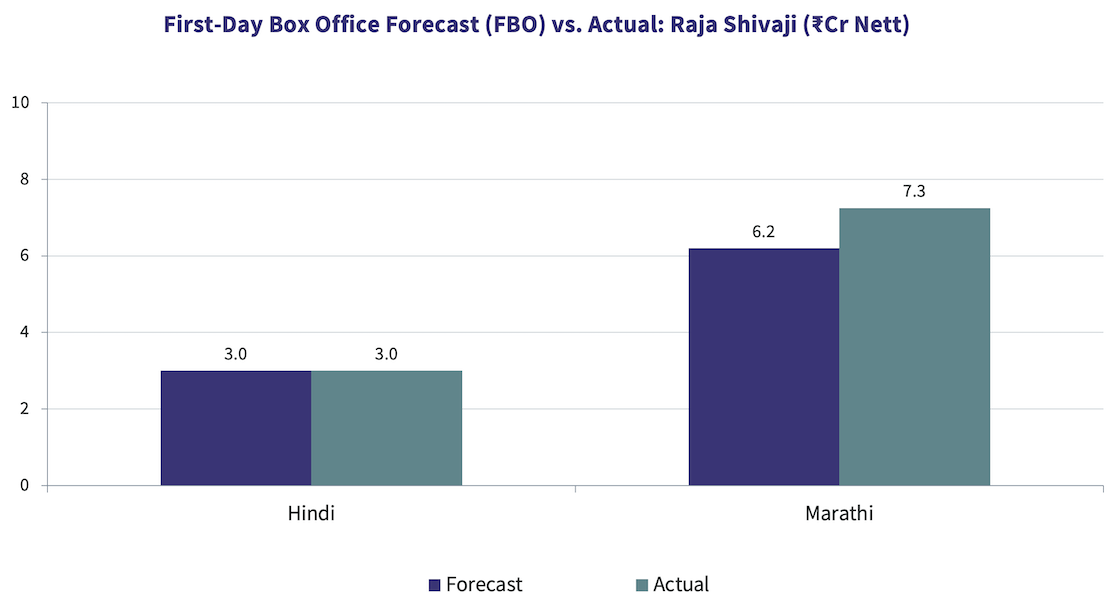
The Marathi version of Raja Shivaji exceeded its forecast, opening at ₹7.3 Cr nett against an FBO of ₹6.2 Cr nett, as the cultural resonance of the film drove non-traditional film audiences to also sample the film with high urgency. The Hindi version was forecast with complete accuracy, opening at ₹3.0 Cr nett, the same as its FBO.
Additionally, the model was also not able to accurately forecast the first day collections of the other major Marathi film released in May 2026, i.e., Deool Band 2, with a wide gap between its actual first day collections of ₹2.3 Cr nett vs. an FBO of just ₹0.5 Cr nett. This is primarily due to an underestimation of the appeal of the devotional premise of the film. Learnings from this wide deviation have been used to update the FBO Model for future releases of this nature.

Ormax Cinematix's FBO: Accuracy update (September 2026)
This edition of our monthly blog summarises Ormax Cinematix's box office forecasts (FBO) for all major September 2026 releases vis-à-vis their actual box-office openings

The India Box Office Report: August 2026
Driven by Hanuman Ansh, Toxic & Irumudi, August 2026 emerged as the best month of the year so far at the India Box Office, grossing ₹1,768 Cr

Ormax Cinematix's FBO: Accuracy update (August 2026)
This edition of our monthly blog summarises Ormax Cinematix's box office forecasts (FBO) for all major August 2026 releases vis-à-vis their actual box-office openings
Subscribe to stay updated with our latest insights
© 2026 Ormax Media Pvt. Ltd. All Rights Reserved.
Ormax Media Pvt. Ltd.
402, Signature,
Captain Suresh Samant Marg,
Andheri West, Mumbai 400053
Phone: +91 9324939911
Get to know us


We use cookies to improve your experience on this site. To find out more, read our Privacy Policy