


Tamil theatrical film Vishwanath & Sons, starring Suriya, premiered on Netflix on September 11, in five languages. As on October 25, the film has clocked 14.8 million unique viewers in India, as estimated by Ormax StreamView, which defines viewership as having watched at least 30 minutes of the film. By the end of its run, Vishwanath & Sons is likely to finish closer to 17-18 million, if not higher. It is the most-watched Tamil film on streaming this year, and second on the list of most-watched South films on streaming this year, after The RajaSaab on JioHotstar (18.1 million), though Bethlehem Kudumba Unit, also on JioHotstar, currently at 12.8 million, is also in the running for the no. 2 position.
The film released theatrically on August 14, and had a fairly successful run, though its streaming performance is even better. The unusual aspect about the film's box office collections was its language breakup. Tamil films have long had a presence in the Telugu market, and a handful of Tamil stars command dependable audiences in Andhra Pradesh and Telangana. Yet for most Tamil releases, the Telugu dubbed version remains a modest add-on to the film's Tamil collections.
Vishwanath & Sons, directed by Venky Atluri, is a notable exception. The film has delivered gross domestic box office of ₹142 Crore, 44% of which has come from its Telugu version.
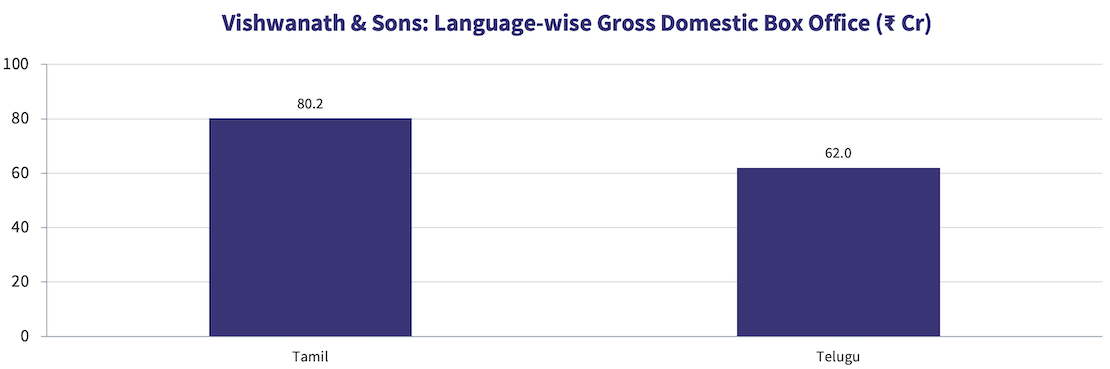
A near-even split of this kind is unusual for a film shot in Tamil and dubbed into Telugu. Two factors helped the film travel across this geographical boundary.
The first is Suriya himself. He is one of the few Tamil stars whose popularity extends firmly into the Telugu market, built over nearly two decades of dubbed successes such as Ghajini, Singam, and 24. Vishwanath & Sons arrived on the back of Karuppu earlier in the year, which kept him at the top of audiences' minds in both states.
The second is the film's Telugu pedigree. Venky Atluri comes off Sir/Vaathi and Lucky Baskhar, and the film is produced by Hyderabad-based Sithara Entertainments. The supporting cast leans heavily on familiar Telugu faces, including Raghu Babu and Sunil Reddy, while Radikaa Sarathkumar, who plays Suriya's mother, has a long filmography in Telugu cinema. For Telugu audiences, the film therefore carried the texture of a homegrown family entertainer. The faces in the household, the comic supporting roles, and the director's treatment all feel familiar, which made it easier to embrace a Tamil star in a film whose original language is Tamil.
On streaming, an estimated 35-40% audiences of the film in India are from the Hindi markets. Vishwanath & Sons has thus crossed two boundaries at once: from Tamil into Telugu in theatres, and from the South into the Hindi-speaking market on streaming. Raveena Tandon's presence gave the Hindi version a recognisable face, though the larger reasons lies in the content itself.
The film's ability to work across languages, and across theatrical and streaming, rests on six content themes:
1. Modern relationship questions that call for inter-generational conversation
The film brings together a wide range of questions around relationships and personal choice, several of which are rarely addressed in a mainstream family entertainer:
These questions are raised within a household that holds a mother, a son and a grandchild, which places them in front of viewers of every age. This gives the film contemporary relevance and creates scope for conversation between generations, across India. This relevance is magnified on streaming, where the rise of Connected TV is leading to family viewing in a category that was consumed predominantly solo till only a couple of years ago.
2. Family at the centre of the narrative
The title itself, with its suggestion of a family legacy and an heir, signals what the film is about. Parenthood, the mother–son bond, and Maddy's (played by Mamitha Baiju) growing attachment to the household, keep family relationships at the centre of the story.
Maddy's friendship with Nirmala (Radikaa Sarathkumar), Sanjay's mother, deserves particular mention. It reinterprets the familiar mother-in-law–daughter-in-law equation through affection, humour and acceptance. Nirmala, with her one-liners and quiet persuasion, gives the film much of its warmth. The result is a film where different generations each have a relationship to connect with. This made it a natural choice for family outings to theatres, and for family co-viewing streaming.
3. Comedic treatment of serious relationship issues
Maddy's pursuit of Sanjay (Suriya), his awkward responses, and Nirmala's participation in their banter, make potentially uncomfortable subjects entertaining to watch. Much of the film's first half plays out as a comedy, even while the questions underneath it are serious.
Humour allows conversations around marriage, sex, and parenthood to unfold with lightness. For younger audiences, a mother teasing her son about his love life is easier to watch with one's own parents than a lecture on the same subject. This broadens the film's entertainment offering, and sustains a fun viewing experience alongside the emotional drama. This broadens the audience set of the film to families, both in the theatrical and OTT contexts.
4. A young, bubbly and impulsive female lead in a shared story
Vishwanath & Sons is a shared-protagonist film. The story belongs to Sanjay and Maddy together, and Suriya's star presence anchors it. Within this structure, though, Maddy carries far more of the story's energy than a conventional heroine in a star vehicle. She sets much of the plot in motion, drives the comedy, and pushes Sanjay to confront what he has avoided.
Maddy belongs to a character type that audiences across languages have consistently embraced: Geet from Jab We Met, Hasini from Bommarillu and its Tamil remake Santosh Subramaniam, Khushi from the television show Iss Pyaar Ko Kya Naam Doon?, to name a few.
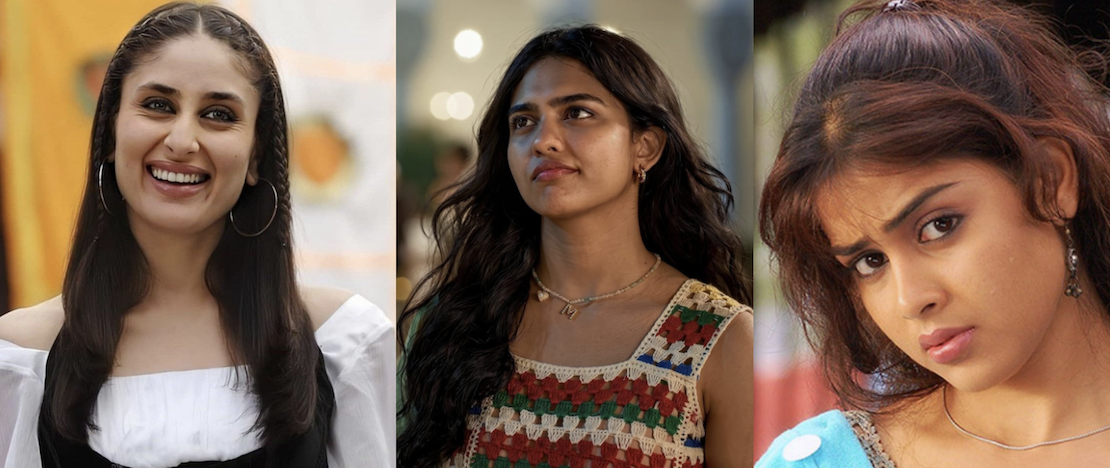
These characters bring spontaneity, mischief and emotional openness to their stories. They say what they feel, often at the wrong moment, and the story bends around them. Maddy's unfiltered expressions of affection allow her to drive the comedy and generate empathy at the same time. Mamitha Baiju, already popular with young audiences after Premalu, brings an ease to the role that makes her impulsiveness endearing.
5. Sensitivity in the male protagonist, alongside familiar protectiveness
Sanjay is affectionate towards his mother, concerned about his child, and restrained in responding to Maddy's advances. He is also the one who takes charge when his loved ones need protection.
The character combines the attentiveness and emotional consideration associated with K-drama romantic leads, with the dependable protector familiar from Indian romances. Suriya, who has played both the brooding action hero and the sensitive lover over his career, is well placed to carry both sides. This accommodates growing expectations of sensitivity from men, particularly among younger women, while retaining the established sources of a romantic hero's appeal.
6. An elite world, mounted with polish and scale
Sanjay is an Olympic medal-winning shooter and a wealthy industrialist. The film moves between a sprawling Chennai home, glass-fronted offices and San Francisco, and is mounted with the gloss of a big-ticket production.
This setting does two things. It makes the film aspirational, in the tradition of glossy family dramas that audiences across languages have long enjoyed. It also makes the story's unconventional choices easier to accept. A rich, globe-trotting sportsman choosing surrogacy, or a young medical student moving into his household, feels plausible. In a middle-class setting, the same choices would invite far more questions.
The polish works particularly well for Hindi audiences on streaming, because the film looks visually distinct from other South Indian films, thus expanding its audience base to older and female audiences, who are not necessarily into watching South cinema dubbed in Hindi otherwise.
In conclusion
Mainstream South Indian cinema has tended to approach subjects like surrogacy, single parenthood and age-gap relationships with caution, often leaving them to smaller, issue-driven films. Vishwanath & Sons places them inside a commercial family entertainer, softened by humour and anchored by a mother–son bond.
As South Indian films find a growing second life on streaming, with Hindi audiences as a significant contributor, the opportunity lies in developing more films that are conceived for multiple markets from the outset. Vishwanath & Sons shows that such films need not rely on spectacle. A well-cast family story, with contemporary questions at its heart, can travel just as far.

Devotional cinema: A leap of faith
After the success of Mahavatar Narsimha last year, Hanuman Ansh has delivered extraordinary box office success in 2026. But can the genre sustain its theatrical momentum going forward?

The India Box Office Report: September 2026
Powered by Mirzapur: The Movie, September 2026 crossed ₹1,100 Cr at the India box office, taking the year’s total to ₹11,000 Cr with three months to go

Ormax Cinematix's FBO: Accuracy update (September 2026)
This edition of our monthly blog summarises Ormax Cinematix's box office forecasts (FBO) for all major September 2026 releases vis-à-vis their actual box-office openings
Subscribe to stay updated with our latest insights
© 2026 Ormax Media Pvt. Ltd. All Rights Reserved.
Ormax Media Pvt. Ltd.
402, Signature,
Captain Suresh Samant Marg,
Andheri West, Mumbai 400053
Phone: +91 9324939911
Get to know us


We use cookies to improve your experience on this site. To find out more, read our Privacy Policy